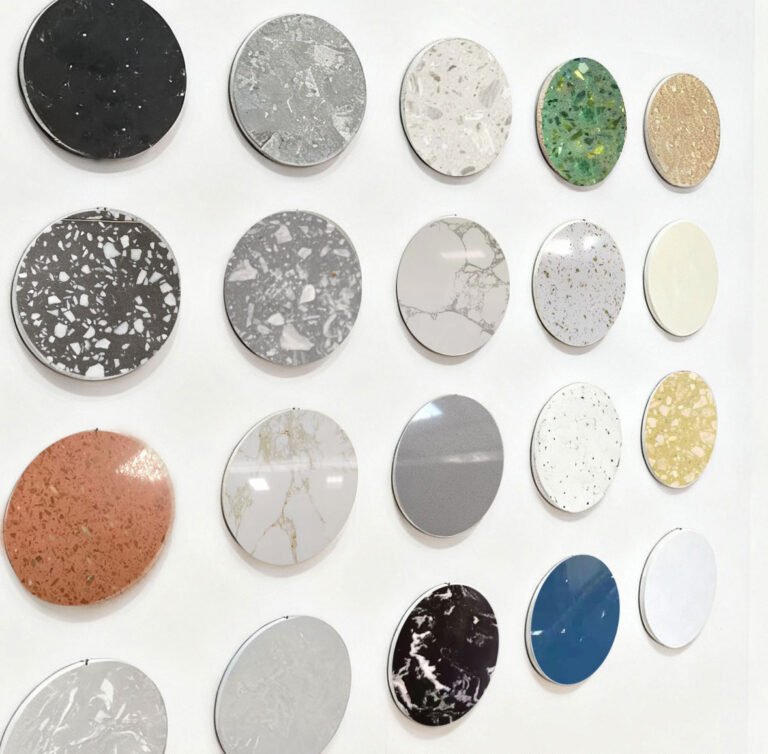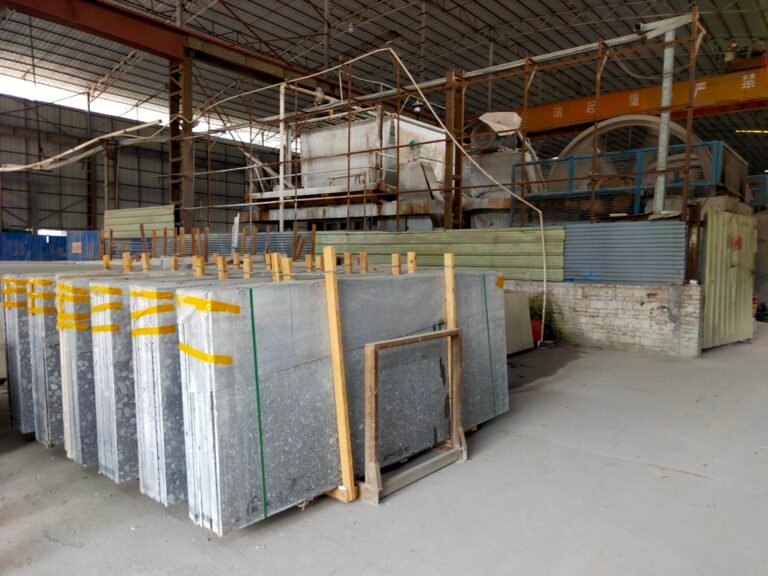
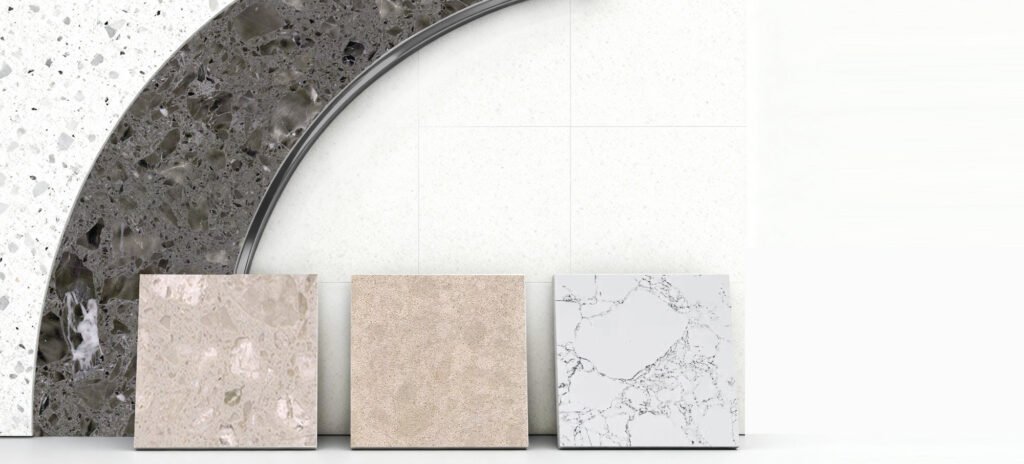
Engineered marble is manufactured using unsaturated polyester resin combined with mineral powder fillers. Additional components include pigments, initiators, and small functional additives.
In most engineered marble formulations, the resin content ranges from 22% to 27%, depending on filler characteristics, particle size distribution, and packing density.
A higher packing density leaves less void space, resulting in lower resin demand. Resin viscosity and flow behavior also influence the final resin ratio.
For high-quality engineered marble, a gelcoat resin layer (0.4–0.6 mm thickness) is typically applied to achieve better surface gloss, abrasion resistance, and durability.
1. Chemical Structure of Resin and Its Importance
The chemical backbone of the resin plays a critical role in the final performance of engineered marble.
In the U.S. market, the most commonly used systems include:
- Isophthalic acid–propylene glycol (ISO–PG) gelcoat resin
- Phthalic anhydride–propylene glycol (PA–PG) engineered marble resin
These formulations can meet the CMI 500-cycle thermal shock resistance standard, making them suitable for demanding interior applications.
2. Key Points When Selecting Resin for Engineered Marble
(1) Standard gelcoat resin (PA–PG) is not sufficient
Traditional PA–PG gelcoat resin does not meet the performance requirements for engineered marble.
Even when using a specialized marble resin, ordinary gelcoat cannot be used for the surface layer.
(2) General-purpose polyester resin (191, 196, etc.) should not be used
Although engineered marble can be made with general-purpose resins, long-term use will lead to:
- Warping
- Deformation
- Surface cracking
Thus, general-purpose resins are unsuitable for industrial production.
(3) The most common commercial solution (best cost-performance ratio)
Using dedicated engineered marble resin paired with:
- ISO–PG gelcoat, or
- PA–neopentyl glycol (PA–NPG) gelcoat
This combination delivers reliable performance at a competitive cost and is widely used in the industry.
(4) Premium system (highest performance)
A high-end combination uses:
- ISO–NPG gelcoat resin
- Paired with ISO–PG engineered marble resin
This system offers superior physical and thermal properties, though at a higher cost.
3. Gelcoat Durability: Comparison of Anti-Whitening & Anti-Blister Performance
Boiling test: engineered marble samples immersed in distilled water and boiled for 48 hours show results consistent with thermal-shock tests.
Performance ranking from lowest to highest:
- PA–PG type
- ISO–PG type = PA–NPG type
- ISO–NPG type (best performance)
ISO–NPG gelcoat provides the strongest resistance to whitening, blistering, and long-term hydrothermal degradation.
4. Resin Curing Performance Requirements
To manufacture high-quality engineered marble, the resin must have:
- Appropriate low shrinkage
- High early-stage curing strength (green strength)
These two factors determine whether the final product is stable, crack-free, and structurally sound.
(1) Low Shrinkage Rate
Shrinkage creates internal stress inside engineered marble.
Excessive shrinkage results in:
- Internal micro-cracks
- Warping
- Surface cracking
- Poor thermal shock performance
A shrinkage rate of 0.7% is generally recommended.
However, even at this low level, residual stress may still exist.
Resins with high styrene content or viscosity below 0.8 Pa·s at 25°C tend to generate excessive shrinkage and should be avoided.
(2) High Green Strength During Early Curing
During curing, the resin transitions from liquid to gel, then to its solid structure.
Two processes occur simultaneously:
- Volume shrinkage
- Strength development
To prevent surface or internal defects:
- The green strength must rise quickly as shrinkage occurs
- Otherwise the gelcoat may pull away from the mold, leading to:
- Gelcoat–substrate delamination
- Matrix cracking
- Internal microfractures
- Reduced thermal shock resistance
High-performance engineered marble requires a resin that builds strength rapidly during early curing to counteract shrinkage stresses.
Summary
Selecting the right resin system is critical for producing engineered marble with:
- Strong mechanical properties
- Stable dimensions
- Excellent thermal shock resistance
- Long-term color and surface durability
- Resistance to cracking, blistering, and whitening
Resin chemistry + curing behavior = final product performance
This is why specialized engineered marble resins and advanced gelcoat systems remain the industry standard.